
Joining up fracture prevention across the East Midlands
Fracture Liaison Services work when data moves as freely as patients do. That was the message from Post Op co-founder and Chief Medical Officer Dr Faizal Rayan at the Royal Osteoporosis Society's East Midlands Regional FLS Forum this week.
The forum brought together NHS trusts, clinicians and integrated care boards from Nottinghamshire, Derbyshire and Lincolnshire. People living with osteoporosis and members of ROS Support Groups sat at the same table. The shared aim was clear: stronger secondary fracture prevention, fewer gaps in care, and fair access to high quality FLS across the region.
A region in one room
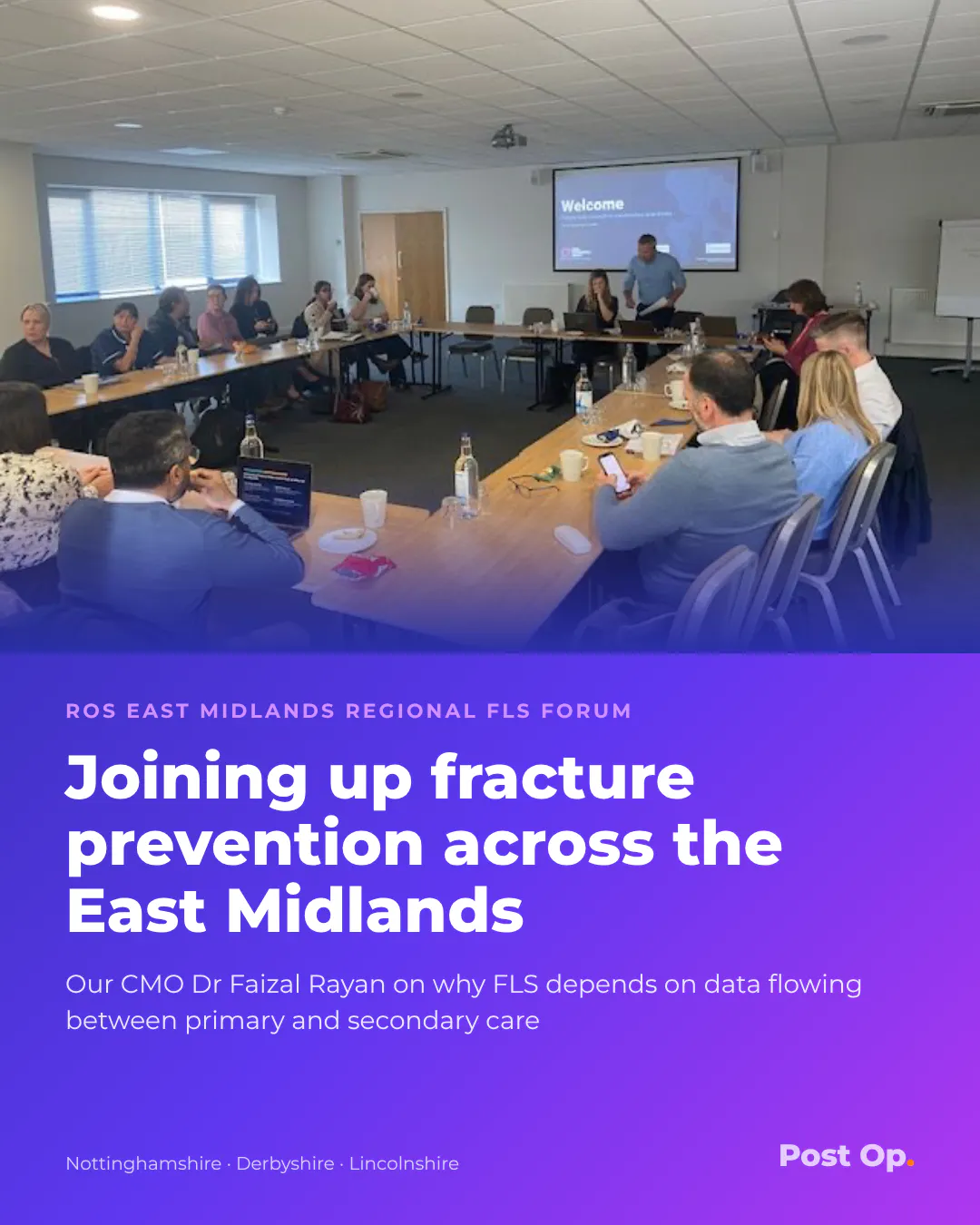

The forum was coordinated by the Royal Osteoporosis Society and Bobby Ancil. Turnout was strong, and the patient voice was present throughout the day.
Reflecting on the event, ROS said:
"There was a real sense of shared ambition to strengthen secondary fracture prevention, tackle gaps in care and improve access to high-quality Fracture Liaison Services across the East Midlands."
The scale of the challenge explains that ambition. According to the ROS, "around one in two women over the age of 50 and one in five men will break a bone because of osteoporosis", with the condition "causing around 550,000 broken bones every year" (ROS, Are you the One in Two?).
The ROS describes FLS as "one of the most effective ways to reduce avoidable fractures" (ROS). Its Director of Services, Ruth Wakeman, has highlighted "the vital role of FLS in ensuring that everyone who experiences a fragility fracture receives the assessment" they need.
Flow between primary and secondary care

Dr Rayan's central point was that an FLS cannot work in isolation. A fragility fracture is usually treated in hospital, but long term bone health is managed in general practice. If information does not travel between the two, patients fall through the gap.
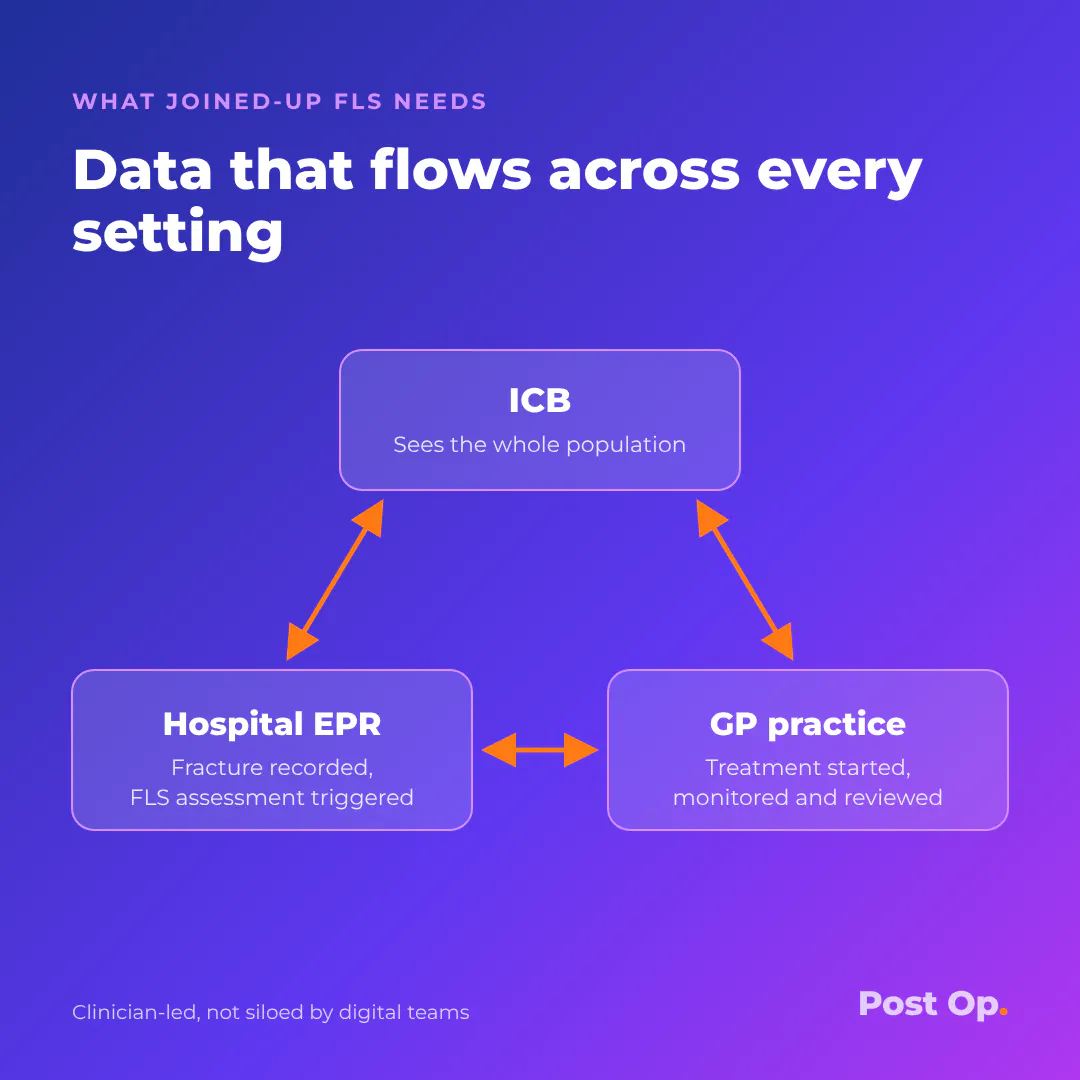
He argued that effective implementation depends on digital data sharing across three layers:
- Secondary care EPR systems, where fractures are recorded and treated
- Primary care systems, where follow-up, treatment and monitoring happen
- The ICB, which can see the whole population and plan services around it
When these systems talk to each other, a fracture in A&E can trigger an FLS assessment, a treatment plan can reach the GP, and the ICB can see who has been missed. When they do not, every handover depends on a letter, a phone call or someone
A clinician-led digital FLS for the region
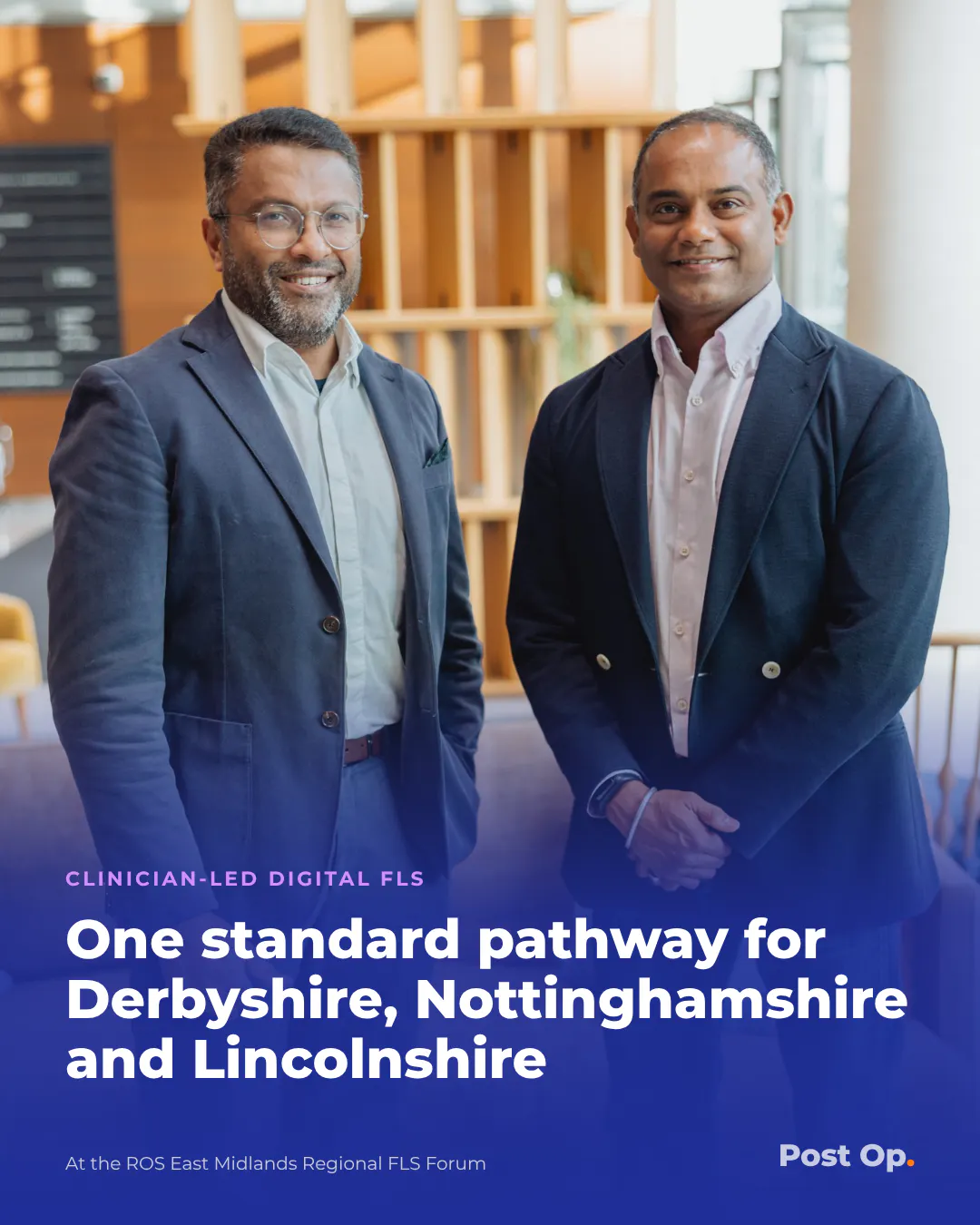

Dr Rayan set out a vision for a single digital FLS across Derbyshire, Nottinghamshire and Lincolnshire. His emphasis was on who leads it.
A digital FLS should be led by the clinicians who run the service and see the patients, he said, not siloed within digital teams. Technology matters, but it has to follow the clinical pathway rather than shape it. When clinicians own the design, the system reflects how fracture care actually works on the ward, in clinic and in the GP surgery.
A regional approach also means one standard across three counties. Patients get the same assessment and follow-up wherever they first present, and services can compare outcomes on a like for like basis.
Where is the urgency?
Every person over 50 is at risk of a fragility fracture. Yet Dr Rayan noted that FLS implementation still lacks urgency. Provision can feel haphazard, and there is no standardised pathway that patients can expect wherever they live.
That inconsistency has a cost. A first fracture is the clearest warning sign of the next one, and every missed assessment is a missed chance to prevent a hip fracture, a hospital stay or a loss of independence.
The ROS has long campaigned to end what it calls "the postcode lottery for FLS" (ROS). A standard, digitally connected pathway is how that commitment becomes reality for patients.
Patients at the centre
Patient groups at the forum agreed that patient involvement is key. People living with osteoporosis know where the pathway breaks down: the missed referral, the scan that never came, the treatment that stopped without review. Their experience should shape how services are designed and measured.
ROS thanked everyone "who joined us, shared their experiences and contributed so openly", noting "lots of energy, collaboration and commitment to build on."
At Post Op, we build digital clinical pathways with clinicians, for clinicians and their patients. We look forward to working with ROS, NHS trusts, ICBs and patient groups across the East Midlands to turn this shared ambition into a joined-up FLS for the region.